
What Is a Gulet? The Turkish Gulet Boat, Its Types and the Gulet Cruise Explained
A gulet is the traditional wooden boat of Turkey's Aegean and Mediterranean coast. Here is what the word means, how gulets are built, their types and sizes, and what a gulet cruise costs.
Also available in: English, Türkçe

Summarize this article with AI
A gulet is a traditional wooden boat from the southwest coast of Turkey, built mainly in Bodrum. It usually has two masts, a rounded stern and a wide deck. Gulets once carried cargo, fished and served sponge divers. Today they are the classic boat of the Turkish “Blue Cruise”, and despite their sails they travel mostly under engine power. This guide explains what the word gulet means, where the boat comes from, the main gulet types, how big a gulet is and how many guests it can take, and what a gulet cruise is like and costs. More than 1,300 gulets are listed for gulet charter on viravira.co. The platform figures in this article come from those listings. The history and technical details come from the Turkish Patent Office, the Bodrum Maritime Museum and academic research.
What Is a Gulet?
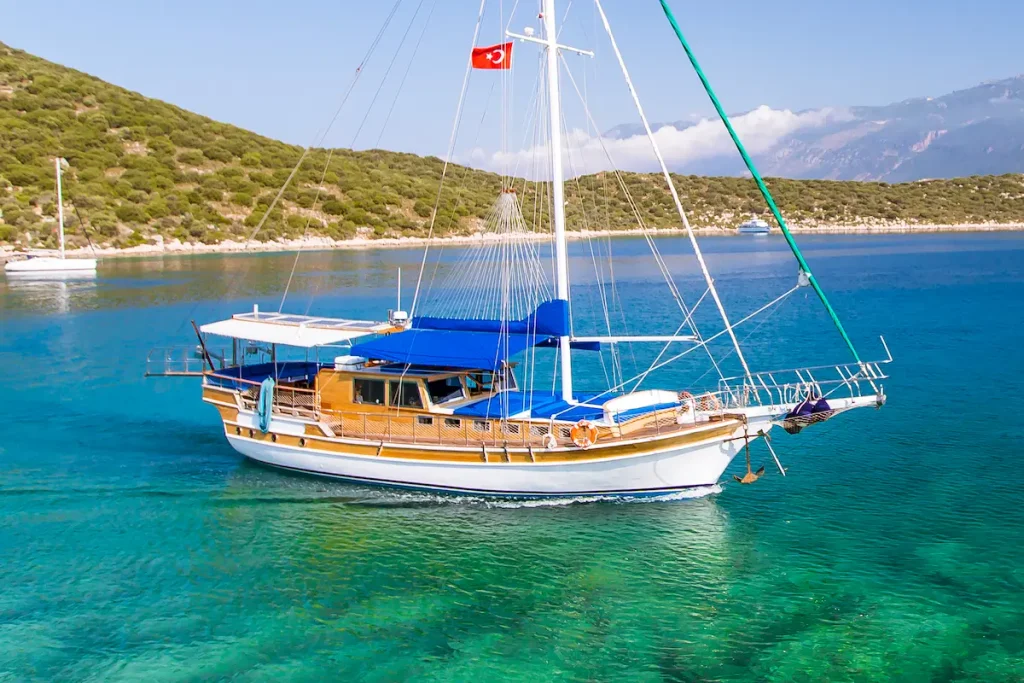
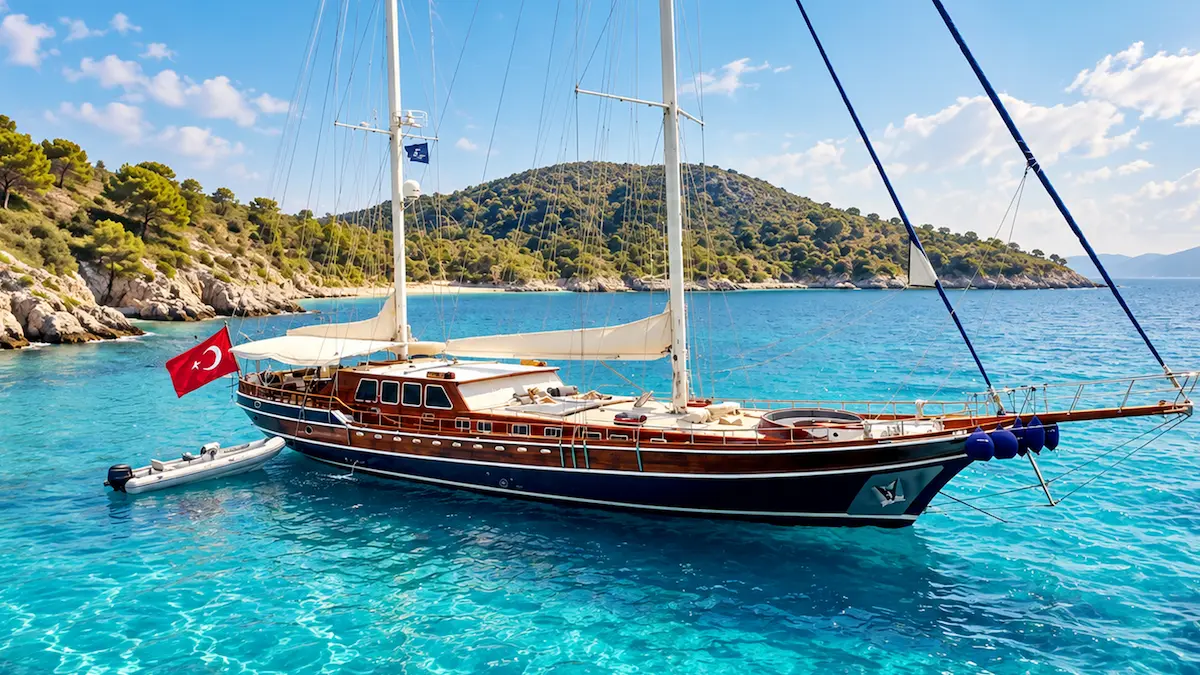
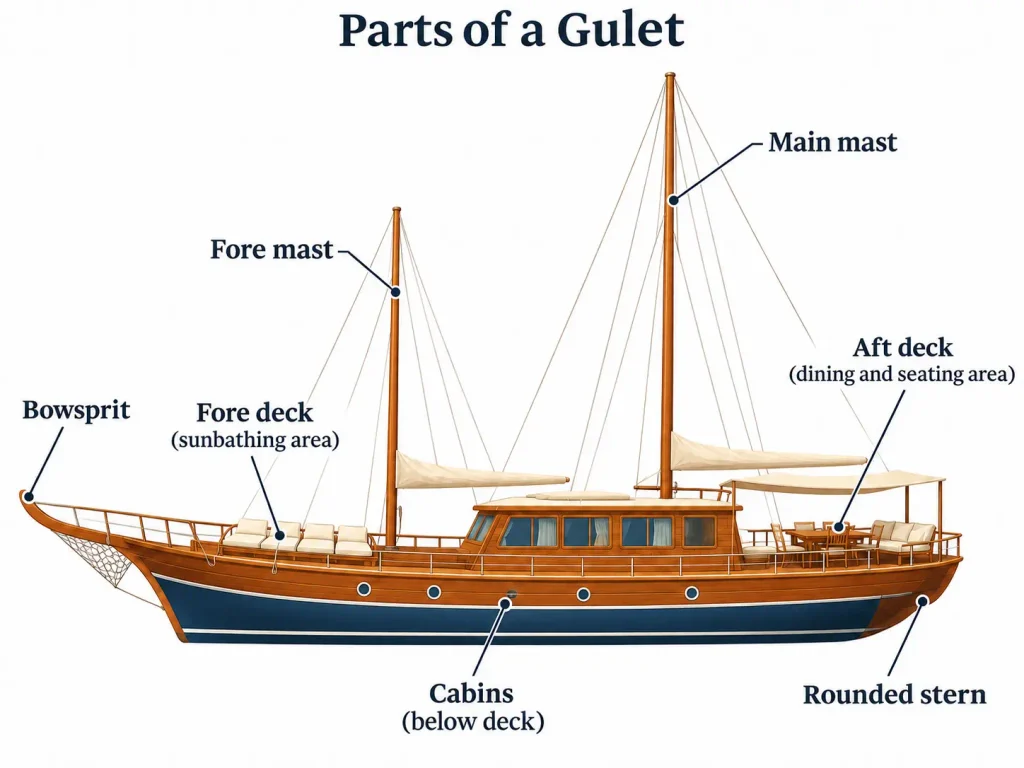
A gulet, or gulet boat, is a traditional Turkish boat known for its wooden hull, broad deck and two masts. In 2024 the Turkish Patent and Trademark Office (TÜRKPATENT) registered the “Bodrum Gulet” as a geographical indication (document in Turkish). The registration describes it as a wooden boat with a rounded stern and a clipper bow. It usually has two masts, with the taller mast at the back and the shorter one at the front.
Today the Turkish gulet’s job is holidays. Its wide aft deck, private cabins and professional crew make it the boat of choice for cruises that move from bay to bay for a few days or a week. Gulets are a familiar sight in the harbours of Bodrum, Marmaris, Fethiye and Göcek, where they are widely used for traditional Blue Cruise holidays.
| Feature | Gulet |
|---|---|
| Hull | Rounded stern and clipper bow. A flat-sterned version (aynakıç) is also common. |
| Material | Traditionally wood. Some gulets are built in steel or composite. |
| Masts | Usually two, three on some large gulets |
| Length | 15 to 50 m (49 to 164 ft) in the Bodrum Gulet registration. The average gulet on viravira.co is about 21 m (69 ft). |
| Cabins | Usually 2–8 cabins on gulets in Turkey, with some larger gulets offering up to 16 cabins. |
| Guests | Gulets in Turkey accommodate around 12 overnight guests on average, with some larger gulets offering accommodation for up to 36 guests, depending on their certification. |
| Propulsion | Mainly engine. Sails go up when the wind is right. |
| Crew | Captain, cook and deckhand. Larger gulets add a hostess or steward. |
| Where it is built | Boatyards on Turkey’s Aegean and Mediterranean coast, Bodrum above all |
Gulet Meaning: Where Does the Word Come From?
In Turkish, gulet is simply the name of this boat. The word itself is a loan. Most sources trace it to the French goélette, meaning “schooner”, which reached Turkish through the Venetian and Italian sailors of the Mediterranean. The Turkish etymological dictionary Nişanyan Sözlük dates the earliest known Turkish record of the word to 1836.
At first, gulet described a rig, not a hull. The Bodrum Maritime Museum explains that the word originally meant the schooner rig and became a hull term in Turkey. Some of those schooner-rigged boats had rounded sterns. So over time “gulet” came to mean a boat with a rounded stern, and the schooner rig took the Turkish name uskuna instead.
How Do You Pronounce Gulet?
In Turkish, gulet is pronounced roughly as “goo-LET”, with the stress on the second syllable (IPA: [ɡuˈlet]). English speakers sometimes misspell the word as “gullet” or “goulette”, but “gulet” is the standard spelling used in the yacht charter industry.
History of the Turkish Gulet: From Cargo Boat to Blue Cruise
According to the TÜRKPATENT registration, the Bodrum gulet was first used to carry cargo and later for fishing and sponge diving. Bodrum’s main sponge-diving boat, however, was the tirhandil. A 2024 PhD thesis on the development of the Bodrum gulet at Istanbul Technical University (in Turkish) names the first gulet-shaped boats in Bodrum as two trawlers, Ege Gülü and Mustafa, built in 1957 and 1958.
The gulet’s second life as a holiday boat began with the writer Cevat Şakir Kabaağaçlı, known as the Fisherman of Halicarnassus. According to the same thesis, he organised the first trip in 1945 on a fishing boat called Macera, together with Sabahattin Eyüboğlu and Bedri Rahmi Eyüboğlu. The writer Azra Erhat joined these trips in 1957. Her book Mavi Yolculuk (“Blue Voyage”) made them famous, and the name stuck. In English it is usually called the Blue Cruise.
The thesis identifies BOTAŞ, a 17-metre (56 ft) boat built by Ziya Güvendiren in 1967, as the first gulet built in Turkey for tourism. As visitor numbers grew in the 1970s, gulets got bigger and gained cabins. From the mid-1980s, builders began making large flat-sterned boats with an extra raised cabin at the back. By the 2000s some gulets were longer than 40 metres (131 ft).
On 9 October 2024, TÜRKPATENT registered “Bodrum Gulet” as a geographical indication under number 1647, following an application by the Bodrum Chamber of Commerce. The name is now protected as a symbol of Bodrum’s boatbuilding tradition and a set of technical features. This does not mean that every gulet built in Turkey or elsewhere carries the indication.
Types of Gulets
The Bodrum Maritime Museum groups today’s Blue Cruise boats into three categories: gulets, aynakıç boats and tırhandils. The clearest difference between them is the shape of the stern, the back of the boat. Strictly speaking, the tirhandil is a different traditional boat, but charter companies often list all three as gulets.
Round Stern Gulet (Karpuz Kıç)
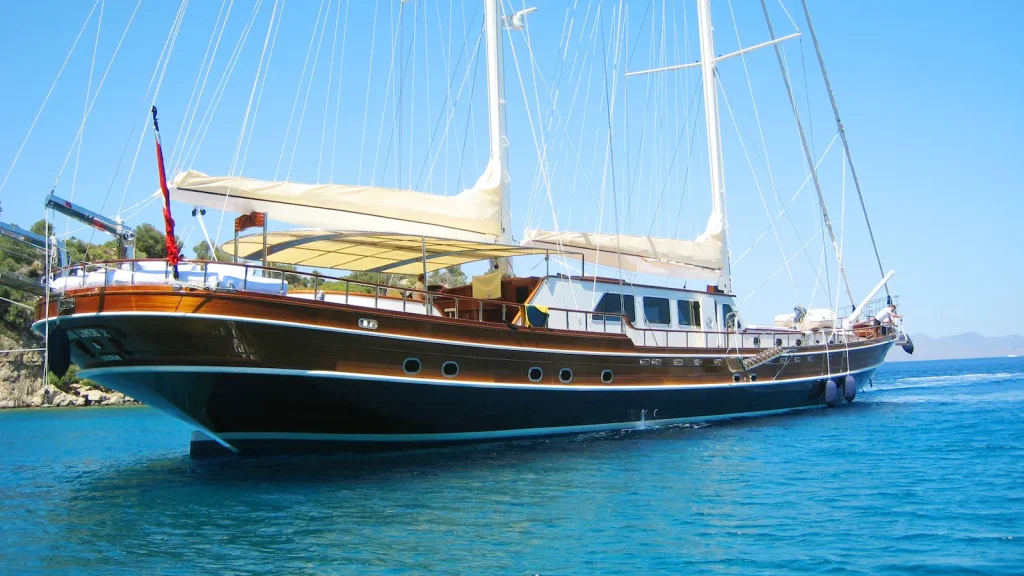
The classic gulet has a rounded stern. The Bodrum Maritime Museum calls “the clipper stem and the round stern” the distinctive features of the Bodrum gulet. Turkish builders call this stern kepçe kıç (“scoop stern”), and in the charter trade the type is often called karpuz kıç, or “watermelon stern”. The TÜRKPATENT registration describes the hull as “heavy, balanced and seaworthy” and says the wide, rounded stern gives the boat its elegant look. In the past, the museum notes, only this round-stern type was called a gulet.
Transom Stern Gulet (Aynakıç)
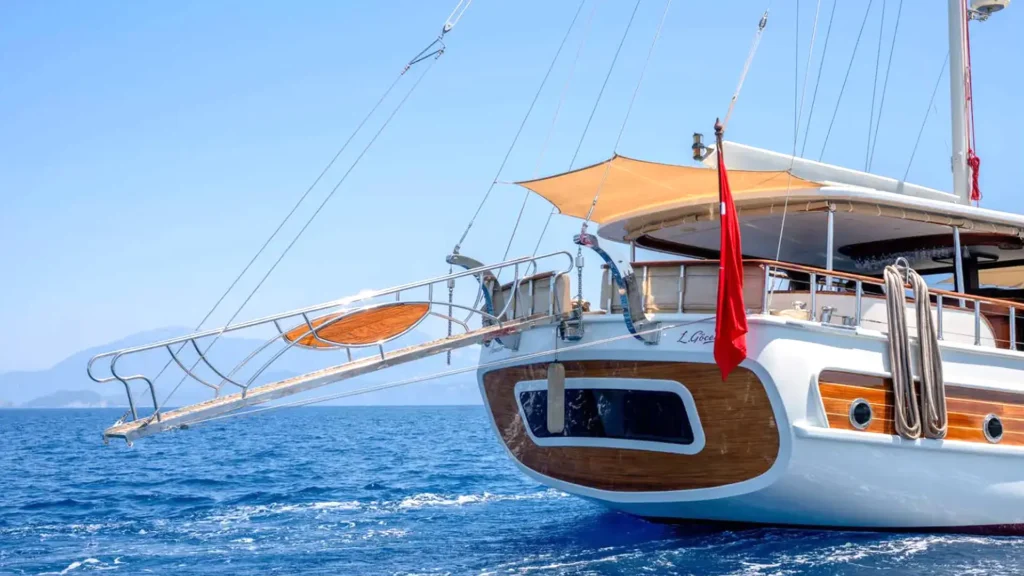
An aynakıç (literally “mirror stern”) gulet has a flat, vertical transom instead of a rounded stern. The museum describes it as “another version of the gulet hull with a square stern rather than a round one”. The flat stern makes room for a bigger aft deck and larger cabins, which is why many charter gulets built for comfort use this form. Today both the round-stern and the transom-stern versions are called gulets.
Tirhandil: The Aegean Double-Ender

The tirhandil is pointed at both ends, which is why the museum calls it the “Aegean double-ender”. Its design probably goes back thousands of years, and it was built in large numbers as sponge diving grew. The ITU thesis dates the tirhandil to roughly 200 years before the gulet, with lengths of 8 to 20 metres (26 to 66 ft). Only a few tirhandils remain among today’s Blue Cruise boats.
| Type | Stern | Main feature | Background |
|---|---|---|---|
| Round stern gulet | Rounded (kepçe, karpuz) | Balanced, classic look | Built as trawlers in Bodrum in the late 1950s |
| Aynakıç | Flat, square | Bigger aft deck and cabins | Large examples from the mid-1980s |
| Tirhandil | Pointed (double-ender) | Narrower and smaller, 8 to 20 m | Oldest type, the sponge divers’ boat |
Gulet types compared. Sources: Bodrum Maritime Museum and ITU PhD thesis on the Bodrum gulet (2024).
How Big Is a Gulet and How Many People Can It Take?
The TÜRKPATENT registration gives a length of 15 to 50 metres (49 to 164 ft) for the Bodrum gulet. Boats outside this range are also sold as gulets in the charter market. The average gulet listed on viravira.co is about 21 metres (69 ft) long.
You will see two different capacity figures. One is how many guests can sleep on board. The other is how many people a gulet can carry on a day trip. On overnight charters most gulets take a maximum of 12 guests, and the reason is regulation. Article 23 of Turkey’s Maritime Tourism Regulation (in Turkish) defines a yacht as a vessel carrying no more than 12 passengers. The same article also covers boats registered as yachts that carry up to 36 passengers, on condition that they stay within 100 nautical miles on coastal voyages and no more than 20 nautical miles from the nearest land. Internationally, the SOLAS convention treats a ship carrying more than 12 passengers as a passenger ship, with much stricter rules. This is the “12-person rule” you often hear about in yacht charter.
Gulet size and capacity also change by region. The table below is based on current gulet listings on viravira.co.
| Region | Gulets listed | Average length | Overnight guests | Cabins |
|---|---|---|---|---|
| Turkey (all) | About 1,300 | ~21 m (69 ft) | 6 to 36 | 2 to 8 |
| Bodrum | 300+ | ~23 m (76 ft) | 6 to 17 | 2 to 7 |
| Fethiye | About 200 | ~21.5 m (71 ft) | 7 to 36 | 3 to 8 |
| Göcek | 150+ | ~20 m (64 ft) | 6 to 16 | 2 to 6 |
| Marmaris | 100+ | ~23.5 m (77 ft) | 6 to 24 | 2 to 8 |
| Croatia | 35+ | ~30 m (97 ft) | 9 to 21 | 4 to 9 |
If you want to see the biggest and best-equipped boats, take a look at our list of the most luxurious gulets in Turkey.
How Is a Gulet Built?
According to the TÜRKPATENT registration, a Bodrum gulet can be built in wood, steel or composite. Wooden gulets are built in one of two ways. The traditional method uses a single layer of planking. The laminated method uses two or more layers, depending on the size of the boat. Construction usually starts by setting up the keel and the stem and stern posts.
Local timber has always mattered. The ITU thesis notes that pine is the most widely used wood in the Bodrum area. Red pine is used for the frames, the ribs of the hull, and black pine for the cabins. Master boatbuilder Erol Ağan, interviewed in the thesis, explains that oak or teak is used for the deck. Laminated hulls also use imported woods such as mahogany and teak.
Does a Gulet Sail or Use an Engine?
A gulet has masts and sails, but it travels mainly under engine power. The TÜRKPATENT registration says it plainly: in the Bodrum gulet, “engine power is mainly used for navigation”. The same document adds that the heavy, balanced and seaworthy hull still allows sailing even in strong winds. A gulet can access many sheltered bays and coastal anchorages, but how close it can approach the shore depends on its draft, local sea conditions and the captain’s judgement.
On a gulet holiday the sails usually go up only for short stretches when the wind is right. If sailing is the main goal of your trip, a sailing yacht is the better choice. A gulet is about time in the bays, a big deck and a relaxed holiday.
Gulet vs Motor Yacht vs Sailboat vs Catamaran
When people plan a boat holiday, the most common question is how a gulet differs from other boat types. The table below compares the four main options.
| Gulet | Motor yacht | Sailboat | Catamaran | |
|---|---|---|---|---|
| Hull | Single hull, mostly wood | Single hull, mostly fibreglass | Single hull, mostly fibreglass | Twin hull, fibreglass |
| Propulsion | Mainly engine | Engine | Sail or engine | Sail or engine |
| Pace | Slow, long stops in bays | Fast, more places per day | Depends on the wind | Moderate, calm and stable |
| Living space | Very large deck | Comfortable interior | Tighter living space | Wide space across two hulls |
| Crew | Chartered with crew | Chartered with a captain | With a skipper, or bareboat with a licence | With a skipper, or bareboat with a licence |
| Best for | Larger groups, families, the Blue Cruise | Speed and luxury | People who want to sail | Families and groups seeking spacious living areas and sailing experiences |
Besides gulets, you can also compare motor yachts, sailboats and catamarans available for charter in Turkey.
What Is a Gulet Cruise?
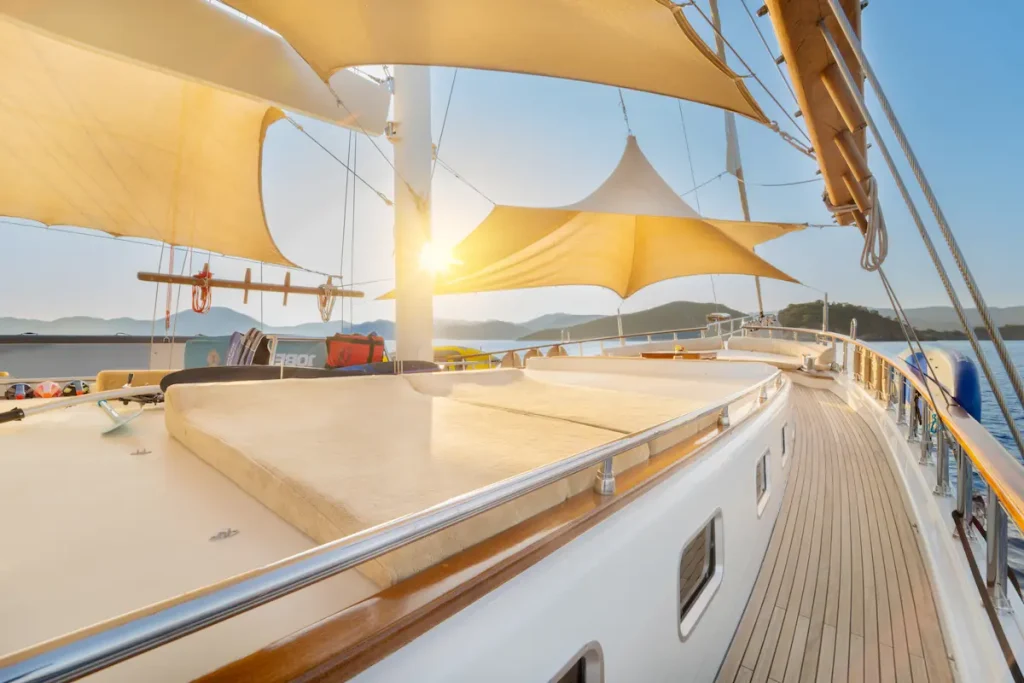
A gulet cruise is a holiday on a crewed gulet that moves from bay to bay along the coast, usually for a few days or a week. In Turkey it is known as the Blue Cruise or Blue Voyage. On a week-long trip the gulet is both your hotel and your boat. Think of it as a small floating hotel.
There are two ways to book one. On a private charter your group has the whole gulet, and you agree the route with the captain. On a cabin charter you book a single cabin and share the boat, the deck and the meals with other travellers on a fixed route. Gulets on viravira.co are listed as crewed charters, so you book the boat together with its crew. Cabin charters are mostly sold by tour operators.
What Is It Like on Board?
The deck usually has two areas. At the back there is a cushioned lounge and a large table where everyone eats together. The front of the boat is kept for sunbathing. The gulet interior is below deck, where the cabins are. On most modern gulets every cabin has its own shower, toilet and air conditioning. The crew have separate quarters.
The crew comes with the boat. The captain handles the route and anchoring, the cook prepares the meals and the deckhand looks after the deck. A typical day starts with breakfast and a short cruise to a new bay. The day is spent swimming, and in the evening the gulet anchors in a quiet cove. Guest reviews on viravira.co provide first-hand insights into the gulet experience, including meals prepared on board, crew service and the overall comfort of the trip.
Is a Gulet Cruise Right for You?
A gulet cruise suits you if you want to:
- Travel with family or a group of friends and share one boat.
- Swim in a different bay every day without packing and unpacking.
- Have a crew do the sailing and the cooking.
- Reach coves that are hard to get to by road.
It may not suit you if you want to:
- Sail the boat yourself or spend most of the day under sail.
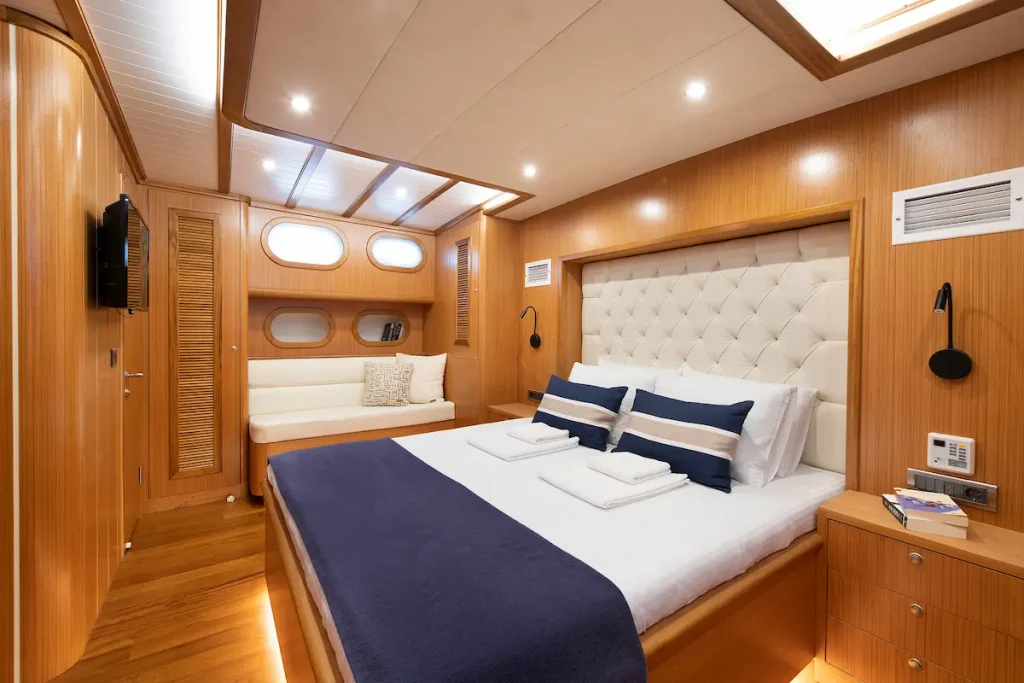
- Have hotel-sized rooms. Cabins on a gulet are compact.
- Cover long distances quickly. A gulet is slow.
Before you book, check exactly what the price includes. Some gulets are offered all-inclusive, while others charge separately for food, drinks or fuel. Our guide to all-inclusive gulet cruises in Turkey explains the difference, and you can find more tips in things to know about gulet charter.
How Much Does a Gulet Cruise Cost?
The price of a gulet charter depends on four things:
- Size and cabins: More cabins and guests mean a higher price.
- Season: Based on viravira.co data, the average weekly price of a gulet in Turkey is about 40 percent higher in high season than in low season. The gap is bigger in Bodrum and Marmaris.
- Charter type: Hourly, daily and weekly charters are priced differently. Overnight trips cost more than day trips. Most gulets are chartered by the day or by the week.
- Region and equipment: The destination, the age and condition of the boat, air conditioning, water toys and the level of service all affect the price.
| Region | Average weekly price (whole boat) | High season vs low season |
|---|---|---|
| Turkey (all) | About €9,000 | About 40% higher |
| Bodrum | About €10,500 | About 50% higher |
| Fethiye | About €10,500 | About 45% higher |
| Marmaris | About €12,500 | About 50% higher |
| Greece | About €19,000 | About 50% higher |
| Croatia | About €25,000 | Not enough data |
These are averages for chartering the whole boat, so the cost per person depends on how many of you share it. Gulets in Croatia cost more on average partly because they are bigger, close to 30 metres on average. Prices change by boat and date, so the listings are always the best guide. You can compare every option on our gulet charter Turkey page, or see gulets in all countries on the gulet charter page.
Where Can You Take a Gulet Cruise?
The gulet was born on Turkey’s southwest coast, and most Blue Cruise routes are still there.
- Bodrum and the Gulf of Gökova: where the Blue Cruise started and where most gulets are built.
- Marmaris and Bozburun: pine-covered bays and a long boatbuilding tradition.
- Göcek and Fethiye: sheltered bays and islands a short cruise apart. We cover them in our guide to the most beautiful coves and beaches of Fethiye.
- Kaş and Kekova: the Lycian coast, with sunken city ruins and very clear water.
If you want to spend a few days on board and explore the coast bay by bay, see our Blue Cruise options.
The gulet is closely linked with Turkey, but you can also charter one on some routes abroad. There are far fewer gulets outside Turkey. On viravira.co there are more than 35 gulets in Croatia, around 20 in Greece, fewer than 10 in Italy and a couple in Montenegro. Gulets in Croatia average close to 30 metres, so they tend to be bigger than in Turkey. To take your gulet cruise abroad, see gulet charter in Croatia, Greece, Italy and Montenegro.
Frequently Asked Questions
In Turkish, gulet is the name of the traditional wooden boat built on the Aegean and Mediterranean coast, usually with two masts and a rounded stern. The word came into Turkish from the French “goélette”, meaning schooner.
Yes. Gulet is the Turkish name for this type of boat and is used as is in English. It is sometimes misspelled as “gullet” or “goulette”.
It is pronounced goo-LET, with the stress on the second syllable.
Gulets are usually 15 to 50 metres (49 to 164 ft) long. The average gulet listed on viravira.co is about 21 metres (69 ft).
According to gulet listings on viravira.co, gulets in Turkey generally accommodate 4–16 overnight guests in 2–8 cabins. However, some larger gulets offer up to 16 cabins and accommodation for as many as 36 guests. The permitted overnight capacity depends on the vessel’s certification and charter conditions.
Under the SOLAS convention, a vessel carrying more than 12 passengers counts as a passenger ship and must meet much stricter rules. Turkey’s Maritime Tourism Regulation also defines a yacht as a vessel carrying no more than 12 passengers. This is why most charter gulets take a maximum of 12 guests overnight.
Gulets are built and licensed mainly for coastal cruising. Under Turkish rules, a yacht licensed to carry more than 12 passengers may only sail within 20 nautical miles of the nearest land. Whether a particular gulet could cross an ocean depends on its construction and certification. Charter gulets are used for coastal holidays, not ocean crossings.
Yes. Under Turkey’s Maritime Tourism Regulation, a yacht is a pleasure vessel with cabins, a toilet and a kitchen that carries no more than 12 passengers. The regulation also allows boats registered as traditional wooden vessels to be certified as yachts if they are built as yachts. This is why charter gulets are often called “gulet yachts”.
Gulets have sails but travel mainly under engine power. On a gulet holiday the sails usually go up only for short stretches when the wind is right.
A gulet is a traditional, usually wooden, single-hulled yacht with spacious decks and crewed accommodation. A catamaran has two hulls, typically offers wide living spaces and generally heels less under sail. Catamarans may be chartered with or without a skipper, depending on the vessel and local regulations. Gulets are particularly popular for traditional Blue Cruise holidays, while catamarans appeal to travellers seeking a modern sailing experience. Comfort and stability depend on the specific boat and sea conditions.
Based on viravira.co listings, a gulet in Turkey costs about €9,000 per week on average for the whole boat. In high season the average is about 40 percent higher than in low season. For current prices, check the listings on the gulet charter Turkey page.
It depends on the boat. Some gulets are offered all-inclusive, while others charge separately for food, drinks or fuel. Always check what the price includes before you book.
Related posts
 Boat types & models
Boat Holiday Alternatives: Sailboat or Motor Yacht?
If you're planning a boat holiday, one of the most important decisions you'll need to make is whether to choose a sailboat or a… Boat types & models
What Is A Motorboat And How To Use It?
A motorboat is a versatile watercraft propelled by an engine or motor, allowing it to navigate through bodies of water such as lakes, rivers,… Boat types & models
The Top 10 Most Luxurious Gulets in Turkey
Gulets are traditional wooden sailing vessels that originated in Turkey and have deep cultural significance in the country. Historically used for fishing and transportation… Boat types & models
Best Sailboat and Catamaran Brands
Sailing is an art as old as civilization itself. It was even just sails and the wind that allowed mankind to explore the world,… Boat types & models
Important Information about Sailboats
From the working principles to the different parts, maneuvers and courses, read all about sailboats here! Boat types & models